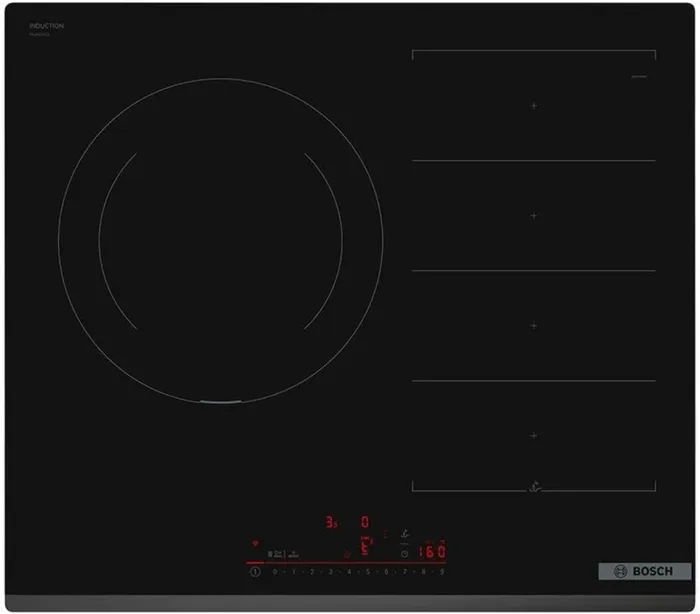
Bosch has built kitchen appliances for over a century, and its induction hobs are the ones most fitters reach for first when reliability matters. The Series 6 PUE611BB5B doesn't try to dazzle with gimmicks; it concentrates on doing the everyday things impeccably, and it does. That focus on fundamentals, paired with Bosch's record for lasting, is exactly what makes it the obvious choice for most kitchens, and our best overall pick in this comparison.
Who is the Bosch Series 6 for?
The Series 6 is the right hob if you want a standard 60 cm four-zone hob that simply works, day in and day out, and you'd rather have proven reliability than chase niche features. It suits the great majority of UK kitchens: it fits the common worktop cut-out, it gives you four zones for a normal household's cooking, and it has PowerBoost on every ring for when you want a pan up to heat quickly. For anyone replacing a tired gas or ceramic hob with a like-for-like upgrade, this is the hob that makes the switch feel effortless.
It's less suited to keen cooks who specifically want a bridge zone for a long griddle or fish kettle, or who want smart connectivity. There's no flexible bridge function here and no app, so if those are on your wishlist the AEG IKB64431XB is the better match. For everyone else, though, the Bosch covers the essentials so well that the extras start to feel optional.
How the Bosch Series 6 performs
Heating speed
In everyday use the Series 6 is fast and decisive. A medium pan of water reaches a rolling boil in a fraction of the time a ceramic hob would take, and with PowerBoost engaged it's faster still, briefly channelling extra power into a zone for those moments when you want heat in a hurry. Crucially, the speed is matched by responsiveness: nudge the power down and the heat drops immediately, which is what makes induction so much more controllable than the gradual fade of a ceramic element.
Control precision
This is where the Bosch quietly shines. The TouchSelect slider lets you tap straight to the power level you want rather than stepping up one notch at a time, and the response is instant and accurate. Holding a low, steady simmer for a delicate sauce is genuinely easy, which is not something you could say of every hob. The 17-step range gives you fine gradations between settings, so you can find exactly the heat a dish needs rather than choosing between "a bit too low" and "a bit too high".
Controls and finish
The glass is clean and well laid out, with clearly marked zones that are sensibly spaced so large pans don't crowd each other. The touch controls are crisp and don't suffer the slightly mushy feel of cheaper hobs. Standard safety features are all present: a child lock that disables the controls, residual-heat indicators that warn you while the glass is still warm, and an automatic shut-off. None of it is flashy, but everything is considered, and it all feels built to last several years rather than one.
The honest downside: no bridge zone and hardwiring
The Series 6 has two real limitations, and neither is a fault so much as a design choice. First, there's no flexible bridge zone, so you can't combine two rings into one long heating area for a griddle plate. If that's central to how you cook, this isn't the hob for you. Second, like almost every built-in induction hob, it draws too much power for a standard socket and must be wired into a dedicated circuit by a qualified electrician. That's a genuine cost to budget for and a step to plan before you buy, particularly if you rent. If a new circuit isn't possible, the plug-in Russell Hobbs double hob is the install-free alternative, though it can't match the Bosch for power or zones.