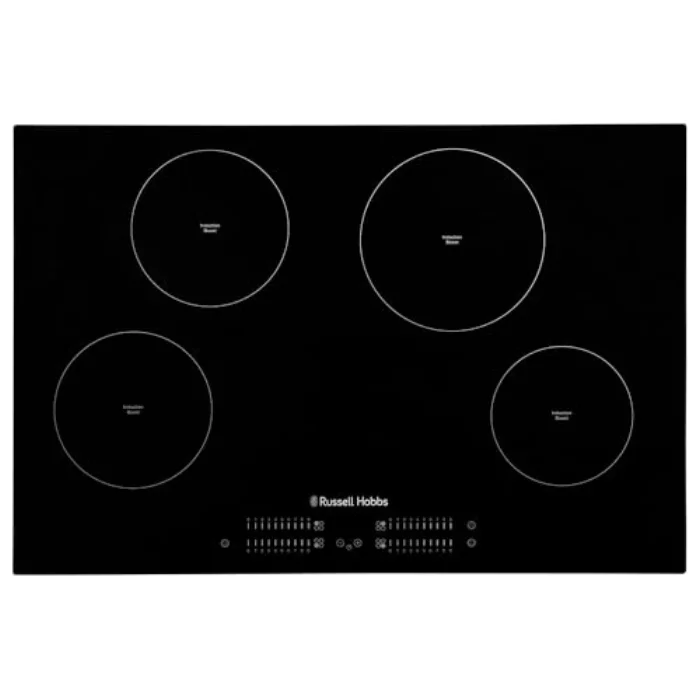
Who is the Russell Hobbs double hob for?
This hob is for anyone who can't, or doesn't want to, fit a built-in hob. Renters who aren't allowed to alter the wiring, caravanners and campervan owners, students in shared kitchens, and anyone who needs an extra couple of rings when entertaining at Christmas: this is the hob for all of them. It plugs into an ordinary socket and is ready to cook in seconds, with proper digital controls and ten power levels, so you get the real induction experience without the cost and disruption of an electrical job.
It's less suited to a permanent main hob in a busy family kitchen. With only two zones and a lower total power than a built-in hob, it can't run a full multi-pan meal at full tilt. If you have the wiring and want a primary hob, a built-in 60 cm model like the Bosch Series 6 or the budget Beko HII64200MT is the better long-term choice. The Russell Hobbs is about flexibility and freedom from installation, not maximum capacity.
How the Russell Hobbs double hob performs
Heating speed
Despite running from a normal socket, the RHDIH103 gives you genuine induction speed on a worktop. A pan of water comes to the boil far faster than it would on a portable ceramic or a gas camping ring, and heat changes are instant, just as on a built-in induction hob. For its intended use, a pan of pasta on one zone and a sauce on the other, it's quick and capable, and a world away from the slow, fiddly portable hobs of the past.
Control and zones
You get two independent cooking zones with their own digital touch controls and ten power levels each, so you can hold a low simmer on one ring while boiling hard on the other. The controls are clear and the power range is fine enough for careful cooking. The key limitation is the shared circuit: because both zones draw from a single 13A socket, the hob manages the total power between them, so you can't have both zones at maximum at once. For everyday two-pan cooking that's rarely an issue; it only shows if you try to push both hard simultaneously.
Setup and portability
This is where it wins outright. There's no installation at all: unbox it, set it on the worktop, plug it in, and cook. It's light enough to move, store in a cupboard, or take to a caravan, and it needs no permission from a landlord and no electrician. That convenience is the entire point, and for people who've assumed induction simply wasn't an option for them, it's a small revelation.
The honest downside: power and zones
The RHDIH103's limits are inherent to its plug-in design, and worth being clear about. It has only two zones, not four, and a lower total power than any built-in hob, and because both zones share one 13A circuit you can't run two large pans at full power together. It is not a replacement for a proper built-in hob in a busy kitchen. But none of that is a fault; it's the trade you accept in exchange for needing no installation at all. If you have the wiring for a built-in hob, choose one; if you don't, this is the realistic route to real induction, as we explain in our buying guide.